Wednesday, 14 August 2013

Now we're on Twitter!

The 1709 Blog now has its own Twitter account at @1709Blog. Do sign up to follow us: apart from keeping you better informed, it also gives you a swift and easy alternative when it comes to making your comments about what we write.

The blog's avatar is Victor Hugo (right),celebrated writer and authors' right activist -- though it may be wondered how the author of the 1,500 page Les Miserables would have coped with the 140-character limitation imposed on each Tweet.

Tuesday, 13 August 2013

Hot Topics in IP - an October date for your diary


This conference takes place on Central London on Tuesday 22nd October and carries 6 CPD hours.

As the Hargreaves Report and the Jackson reforms continue to impact in the United Kingdom, this one-stop shop update from industry leaders in intellectual property will provide valuable guidance on current and future developments. 

Chaired by Peter Brownlow, Partner at Bird & Bird, speakers will include:

- Michael Hart, Partner at Baker & McKenzie, who will analyse recent comparative advertising case law and the impact of recent developments in trade mark law

- Martin Howe QC of 8 New Square who, having successfully represented Rihanna in the image rights claim against Topshop owner Arcadia, will provide an update on the status of image rights in the UK

- Guy Burkill QC of Three New Square, who will share invaluable insights into current mobile phone patent litigation strategies

- Mark Owen, Partner at Taylor Wessing, who will review copyright law in the UK and the potential impact of new exemptions

- Duncan Ribbons, Partner at Redd, who will consider the impact of the Jackson reforms on IP litigation

- Paul Gardner, Partner at Osborne Clarke, who will offer industry expertise on the evolution of interactive.
   
And even better - 1709 readers can receive 20% off the full delegate rate of £599 (plus VAT). Quote code MLU20. Book your place at www.conferencesandtraining.com/IP-update or email alicia.sprott@lexisnexis.co.uk.

No summary judgment where copyright claim is mixed up in more knotty issues

Sorry about the delay in posting this note: Devonshire Pine Ltd v Day has been at the back of my mind for a while, but I keep getting distracted. Devonshire Pine Ltd v Day is a Chancery Division, England and Wales, decision from 19 July, handed down by Stuart Isaacs QC, sitting as a Deputy Judge. It hasn't found its way on to BAILII and is in probability not going to do so.

In short, this was an application by Devonshire Pine for summary judgment in its claims against Day for copyright infringement and breach of statutory duty. According to Devonshire Pine, Day had taken copyright-protected photographs from its website and then published them, without authorisation, on the latter's own website, and was then indulging in "reverse passing off" by creating the impression that the items portrayed in the photos of Devonshire Pine were those of Day.  Day however denied any liability, asserting that the images in question had been provided by a company in China, where similar images were commonplace. Devonshire Pine made a further allegation that Day had, as a person providing an information society service on a website, failed to make available its name, address and other details as were required under the Electronic Commerce (EC Directive) Regulations 2002 (here), reg. 6. Again, Day denied liability, maintaining that the requirements of the Regulations had been fulfilled and that, in any case, Devonshire Pine had failed to show that it had suffered loss.

As to the application for summary judgment, Day submitted that there was a compelling reason for the infringement claim to go to trial because a grant of summary judgment on the copyright infringement claim would determine an issue in the related reverse passing off claim, which was too complex to be dealt with summarily. Also, Devonshire Pine actually had to establish a case in respect of the breach of statutory duty; the mere absence of a detailed defence was not a sufficient basis for a summary judgment application.

Stuart Isaacs QC refused the application for summary judgment.

A factual connection between the copyright infringement claim and the reverse passing off claim did exist. Although there were grave doubts about the prospects of Day's defence to the infringement claim, there was still a compelling reason for the matter to go to trial since there would in any event still be a trial of other issues and even Devonshire Pine accepted that there was a factual overlap between these two claims. It was therefore appropriate to determine all of the issues together -- even though Day's prospect of success in defending the copyright claim was so poor.

Regarding damages for breach of statutory duty in failure to comply with the 2002 Regulations, the court was not satisfied that this breach was enforceable by Devonshire Pine as a recipient of an information society service suffering damages. It was uncertain whether Day was a supplier  of an information society service within the meaning of the Regulations, since there was an arguable distinction between Day as a company and Day's director in relation to the provision of the service. It was also unclear whether Devonshire Pine was to be treated as a recipient for the purposes of the regulations.

The moral of the story seems clear: if the claim had been based on copyright infringement alone, Devonshire Pine would have had judgment on a plate -- and surely, since the IP Enforcement Directive, the court could order the same damages in respect of copyright alone as it would order for copyright infringement plus reverse passing off (this is a controversial point: readers, please discuss!).

Saturday, 10 August 2013

Fair use? Australian content owners say NO

As if by magic, and no doubt having spied the 1709 Blog and IPKat's new 'fair use' poll (see the sidebar), the Australian copyright industry has responded to proposals by the Australian Law Reform Commission to introduce a new regime of fair use in Australia in the ALRC's June 2013 discussion paper. 

Simon Bush, Chief Executive of The Australian Home Entertainment Distributor's Association (AHEDA) said a regime based on fair use would lead to an increase in piracy and require litigation to be defined, saying the change “would put pressure on copyright owners to litigate directly against consumers.”  He continued:  “We don’t want to be suing end users. It’s the very last thing we want to do and any policy proposal that says you need to litigate is flawed.
adding "It's a solution looking for a problem that doesn't exist". 

Back at the end of June, the Screen Production Association of Australia has warned about the proposed easing of copyright laws with SPAA’s executive director Matthew Deaner blasting recommendations by ALRC saying the reform body's “thinking is out of touch with commercial reality and shows no understanding of the issues facing our sector adding “These views, if left uncorrected, would undermine many legitimate sources of income.”

What do you think? You can have your say on our sidebar where we ask "Do you think that the US fair use defence really makes a difference in terms of user freedoms?".

More here and here

Friday, 9 August 2013

The CopyKat - transformed, trans-Pacific, topped up but not transferred

The National Music Publishers Association (NMPA) has filed a copyright infringement suit in the US against Fullscreen Inc., a Multi-Channel Network (MCN) operating on YouTube and largely comprised of independent artists playing cover songs - allegedly without proper licensing or paying royalties although Fullscreen also services over 10,000 YouTube channels, including those owned by NBCUniversal, Nintendo, and Lexus. According to a statement from the NMPA they are alleging that Fullscreen "directly profits from advertising revenue generated by unlicensed music videos on their channels, but does not compensate songwriters or publishers." YouTube's own 'blanket' licences seemingly do not extend to  the growing number of Multi-Channel Networks.

Transformative art and fair use are quite the hot dinner party topic now if recent US court decisions are anything to go by. Hot on the heels of a case looking at the transformation of photographs of Rastafarians. comes a new decision that will cheer all American Idiots.


Seltzer's Scream Icon
Green Day's video
The US 9th Circuit court of appeals has ruled that US punk band Green Day did not infringe copyright when they used an artist's drawing of a screaming face in a video backdrop. Referencing Cariou v Prince, the other recent case on transformative art  (for more, see Jeremy's blog here), the court ruled that the band had transformed the work of Los Angeles-based artist and illustrator Derek Seltzer and were protected by the doctrine of fair use. Seltzer launched his action in 2010, saying the band had used his drawing "Scream Icon” without permission: a poster of the image had been photographed  by Green Day’s set designer Richard Staub on a wall on Sunset Boulevard in 2008 and later incorporated image into a four-minute video backdrop for Green Day's song "East Jesus Nowhere", a song about religious hypocrisy but the court said the fact the image was altered by a red spray-painted cross meant the image had been sufficiently transformed to become fair use.  At trial, Judge Philip Gutierrez granted summary judgment for the band and also legal fees of $200,000 seemingly unimpressed with Seltzer's claim: whilst the ruling was upheld, the award of legal fees was overturned as the appellate court, with Judge Diarmuid O'Scannlain for the court saying he found the decision "close and difficult".

I wondered if I blogged from now on in unusual shapes (my attempt at shapes above) the CopyKat could also fall under 'fair use' even when disgracefully copying other's efforts. Well, a slightly daft idea - but why not voice your opinion in our poll on the sidebar where the 1709 and the IPKat blogs are asking "Do you think that the US fair use defence really makes a difference in terms of user freedoms?".

Michael Geist blogs that the "U.S. Copyright Lobby Takes Aim at Canadian Copyright Term Through Trans-Pacific Partnership" saying that the U.S. copyright lobby, led by the International Intellectual Property Alliance, "appeared last week before a U.S. Congressional Committee hearing on the Trans-Pacific Partnership and made it clear that it wants the U.S. to use the trade agreement to force Canada to extend the term of copyright.  Canadian copyright law is currently at life of the author plus 50 years, which meets the international standard found in the Berne Convention. The U.S. extended its copyright term years ago to life of the author plus 70 years under pressure from the Disney Corporation (Mickey Mouse was headed to the public domain) and has since pushed other countries to do the same". More from Professor Geist on this here.


Despite a $10 million copyright and trademark suit, a new movie about the early life of the Deep Throat actress Linda Lovelace will hit movie theatres. Arrow Productions claims that The Weinstien Company distributed Lovelace uses 5 minutes of uncleared footage from from their Deep Throat film and benefits from the use of the name 'Linda Lovelace' which it has trademarked.  US District Judge Thomas Griesa rejected Arrow's request for a temporary injunction to stop the August 9th release, but the defendants, The Weinstein Company, Radius, Millennium Films, Nu Image, Inc., Animus Films, Untitled Entertainment, Inc., Eclectic Pictures, Inc., Avi Lerner and Laura Rister, still face a $10 million damages claim from the copyright owners. Amanda Seyfried stars in the new biopic and on the news that the injunction was nor granted the film's producers said that they "couldn’t be more pleased the world will finally get a chance to see Linda’s real story unfold on screen in Lovelace. Never again will she be silenced by the producers and distributors of Deep Throat”.

puuuuuurfect
Russia's new anti-piracy legislation, launched to combat 'high value' online piracy of movies and TV shows, is being amended to include music, photos and other images as well as text-based material. The Ministry of Culture says it will now begin changing the legislation.
and as well as including a wider range of creative content, the amendments will mean that site owners will be required by law to display their 'real-world' addresses alongside their email addresses on their websites in order to speed up correspondence and a streamlined system for complaints - or face being blocked.

Don't forget to vote!
The British Copyright Council has appointed a new Independent Code Reviewer. Walter Merricks CBE, formerly the Chief Financial Ombudsman, was appointed by a selection panel chosen to represent the interests of both rights holders and copyright users. Mr Merricks will conduct a review of the BCC's 'Principles of Collective Management Organisations' Codes of Conduct' following the first full year of implementation, to ensure that it remains fit for purpose. The BCC developed its Principles policy document to establish a framework of good practice for Collective Management Organisations (CMOs) and a set of minimum terms to be used as the basis for CMOs individual Codes of Conduct. Fourteen CMOs have now adopted these guidelines. The review will also reference the Government's October 2012 benchmark recommendations 'Minimum Standards for UK Collecting Societies'. Founded in 1965 and incorporated in 2007, the British Copyright Council is a not-for-profit organisation that provides a forum for discussion of copyright law and related issues at UK, European and International levels. 

RT reports that the Swedish Pirate Party has celebrated the 10th anniversary of the Pirate Bay torrent website by reporting the country’s publicly anti-piracy IT minister, Anna-Karin Hatt, to the Swedish Police for infringing copyright on several occasions. The party has been following Hatt’s account on Instagram, where it alleges that the politician is anything but innocent when it comes to respecting the legislation which she claims to so strongly support: It seems Karin-Hatt posted copyrighted Calvin and Hobbes cartoons as well as artwork for several movies, including The Lord of the Rings, The Da Vinci Code, and Monty Python and the Holy Grail - well that's according to a blog by the Pirate Party’s legislative spokesman, Torbjörn Wester.

The Hulk, Thor, Captain America and Iron Man
And finally, the 2nd U.S. Circuit Court of Appeals has upheld the decision by District Judge Colleen McMahon who in July 2011 ruled for Marvel in a dispute with the heirs of comic book artist Jack Kirby, finding artwork and characters he had drawn constituted works for hire under the Copyright Act of 1909.and that the family have no rights to characters such as the Hulk and Fantastic Four. These are owned by Marvel Entertainment, a Walt Disney Co subsidiary. Walt Disney bought Marvel for $4 billion in 2009. "Iron Man 3," the latest Marvel movie based on a character Kirby helped create, has grossed $1.2 billion worldwide. Kirby's other creations include Thor and Captain America (Marvel Characters, Inc. v. Kirby, 2nd U.S. Circuit Court of Appeals, No. 11-3333).

Tuesday, 6 August 2013

The CopyKat - Konverting to Kopimism?

With Russia’s new anti-piracy law just a few days old, new opposition will be voiced in a particularly unconventional manner it seems: Internet activists in several parts of the country have applied to form their own church. Official complaints will then be filed against the new law on the basis that it insults the beliefs that underpin the Kopimist religion. The church’s founders plan to file a lawsuit against the anti-piracy legislation on the basis that the law, which restricts copying and sharing, is an insult to Kopimists, and possibly onwards by way of an appeal to the Constitutional Court of the Russian Federation

The new Russian Kopimist church will closely follow the values pioneered by Sweden’s Church of Kopimism, a religion that was formally recognized by the authorities there in 2012. This means that it’s likely that CTRL+C and CTRL+V will likely be held as sacred symbols, and the acts of sharing and copying will be viewed as “the most beautiful things in the world”. The church also believes that the search for knowledge is sacred, the circulation of knowledge is sacred, the value of information increases the more it’s spread and, that while confidentiality is sacred, listening in to other people’s conversations is the greatest sin. Eleonora first reported on Kopimism on the 1709 Blog back in May 2012.

Amusing yes. But this CopyKat is not convinced that playing with the church in Russia is a particularly good idea. It cannot have escaped anyone's notice that two members of the feminist protest group Pussy Riot remain in prison in Russia after being convicted on charges of hooliganism motivated by religious hatred after a protest against Vladimir Putin at Moscow's Russian Orthodox Cathedral. Both were sentenced to two years in prison and one, Maria Alyokhina, was recently refused parole. Alyokhina, who has a five-year-old son, is now scheduled to remain in prison until March 2014. The same is true for her Pussy Riot band-mate, 23-year-old Nadezhda Tolokonnikova. A third member, Ekaterina Samutsevich, was freed last year.

And back to the new religion. I wonder just how welcome these statements will be to the Russian authorities: 

Copy. download, upload!
All knowlegdge to all!
Information technology is not to be feathered by laws.

Turtles probe the murky soup of pre-1972 US copyright law

The Turtles
The Turtles are leading a $100 million lawsuit against SiriusXM, arguing that the satellite broadcasting company has infringed on millions of older recordings from thousands of artists, and that Sirius cannot rely on section 114 of the US Copyright Act for protection – as pre 1972 recordings are subject to state law – which may arguably mean that Sirius plays songs recorded before that date without permission. The suit, brought under the California Civil Code, and led by vocalists Howard Kaylan and Mark Volman (later known as Flo and Eddie whose company leads the action and owns copyrights in a number of Turtle's sound recordings) was filed on August 1 in the Los Angeles Superior Court and is proposed as a class action. 

Are the Turtles' "Let Me Be" (1966), "You Baby" (1966), "Happy Together" (Billboard Hot 100 Number 1 in 1967), "Elenore" and "You Showed Me" (both peaking at No. 6 in 1969) and their well-known 1965 cover of Bob Dylan's "It Ain't Me Babe" protected against unauthorised plays by Californian state law (Californian Civil Code S980(a)(2)?  Sirius does currently pay compensation for the use of sound recordings (unlike terrestrial stations in the USA) at a rate set by the Copyright Royalty Board and the non-profit SoundExchange collects and distributes these royalties. Whether they collect for heritage acts is another matter – it seems Sirius did not, until recently, log or report all plays and does not report tracks played from before 1972 (meaning the recording artists and indeed their labels seemingly don’t get paid!).

Interestingly  in April this year in the 'Grooveshark' litigation, a New York state appeals court ruled that the safe harbour provisions of the Digital Millennium Copyright did not extend to per-1972 recordings as this was when Congress first recognized a federal copyright for sound recordings – although as Iona pointed out in her blog at the time, this flies in the face of previous decisions: last year, the Manhattan Supreme Court relied on the 2011 federal ruling in Capitol Records v. MP3tunes, to find "no indication in the text of the DMCA that Congress intended to limit the reach of the safe harbors provided by the statute to just post-1972 recordings." In 1972, in Goldstein v. California, the U.S. Supreme Court held that "Until and unless Congress takes further action with respect to recordings fixed prior to February 15, 1972, the California statute may be enforced against acts of [copyright] piracy such as those which occurred in the present case."

Spin reports that The Turtles have a history of taking disputes to court. The band sued their own label in 1971, citing accounting irregularities, and ended up earning the rights to their songs' original masters. Many years later, they filed suit against De La Soul for damages of $1.7 million over a 1989 sample of  the Turtle's 1969 hit "You Showed Me." That case was settled out of court.

Sunday, 4 August 2013

The CopyKat: Kiwis, eagles and mockingbirds - all on this Kat's takeaway menu.


Viacom has asked for a new judge it its now seven year battle with YouTube saying in papers filed to the appellate court (Second Circuit) "Given the protracted nature of this litigation (the case is now well into its seventh year) and the evident firmness of the district court’s erroneous views regarding the DMCA, this Court should exercise its discretion to remand the case to a different judge 'to preserve the appearance of justice.” Viacom believes that the popular video sharing site  “made a deliberate effort to avoid guilty knowledge" - a fact-finding mission that Viacom believes deserves a trial.

YouTube co-founder Chad Hurley has told the Austrialian Financial Review that people should be able to see any program anywhere at anytime saying “I think the business models are breaking down and the companies that are going to win in this new world are the ones that make it as easy as possible for the consumers to consume the content wherever and whenever they want.”

Rather amusingly it seems that Microsoft has sent a series of takedown notices to Google asking the online giant to takedown ‘infringing material’ that happens to reside on its own official Microsoft websites, including Microsoft's official store, Microsoft's official support page, Microsoft's official Office page and the main Microsoft.com page. The DCMA takedowns were sent by LeakID on behalf of Microsoft. In other news, Google say that by adding up all the weekly takedown numbers it estimates that since January this year it has been asked to remove over 105,300,000 links to infringing URLs. Today, most of these URLs fail to appear in Google's search results. While the takedown requests appear to be levelling off a little, the 100+ million URLs is already double the number Google processed for the whole of 2012. And following in the footsteps of Google, Twitter says copyright takedown requests are up 76% on the final six month period of 2012.


Despite new laws to protect them, it seems most major German publishers have allowed Google to keep using their content on its news page. However, they insist that their dispute with the search giant over payment for content isn’t over. German publishers including Axel Springer – whose publications include the newspapers Die Welt and Bild – had lobbied for German copyright law to be extended to cover the snippets of stories Google displays in its News service. They also lobbied for search engines to pay publishers to display these news snippets. But it’s one of several big German publishers that have apparently opted into Google News.


Former Radio 1 DJ Judge Jules is joining London based firm Sheridans as a trainee in September. He said he plans to continue as a DJ in his own time.

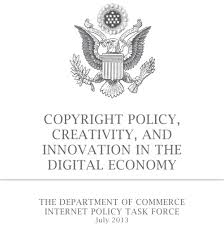
The U.S. Department of Commerce has released a green paper on Copyright Policy, Creativity, and Innovation in the Digital Economy to advance discussion on a set of policy issues critical to economic growth. The report is a product of the Department of Commerce’s Internet Policy Task Force (IPTF) with input from the U.S. Patent and Trademark Office (USPTO) and the National Telecommunications and Information Administration (NTIA) who will solicit further public comments and convene roundtables and forums on a number of key policy issues. In the Green Paper, the IPTF proposes establishing a multistakeholder dialogue on improving the operation of the notice and takedown system under the Digital Millennium Copyright Act (DMCA) and soliciting public comment and convening roundtables on the legal framework for the creation of remixes; The relevance and scope of the first sale doctrine in the digital environment; The application of statutory damages in the context of individual file-sharers and secondary liability for large-scale online infringement; and the appropriate role for the government, if any, to help improve the online licensing environment, including access to comprehensive public and private databases of rights information. It also reiterates the administration's support for legislation creating a performance right for broadcasting sound recordings -- something broadcasters are strongly opposed to. http://www.broadcastingcable.com/article/494810-IPTF_Proposes_New_Look_at_Copyright_Fair_Use_Online.php

In our last CopyKat, we reported on House Judiciary Committee, which launched a “comprehensive review” of copyright law, and the Subcommittee on Courts, Intellectual Property, and the Internet’s hearing on “Innovation in America: The Role of Technology.”  Week One heard from content owners such as Getty Images whose business model is built on exploiting – and protecting – their copyrights: In contrast, in Week Two  the Committee had witnesses who included organisations that have employed alternative models to profit from the creation of works:  Indiegogo provides a crowd-sourcing platform that allows fans to support artists and their projects directly (while taking a 4 percent cut);  Rackspace developed with NASA an open source cloud computing system, OpenStack. Rackspace makes the OpenStack code and documentation freely available, and derives revenue from providing services built on OpenStack; SparkFun Electronics manufactures and sells 450 open source electronics components. For any component, SparkFun expects to have three months exclusivity before the component is copied by a competitor. Thereafter, SparkFun competes by improving the component and providing better customer support.  It incorporates innovations developed by competitors, and then adds its own. It maintains its market share through constant innovation rather than assertion of IP rights. It will be interesting to see what the Committee makes of such divergent models and the tension between the possibilities offered by new – disruptive – technologies, and traditional business models. Comment from DisCo – the DisruptiveCompetition Project -  here. And comment on New Zealand's proposed legislative reforms for copyright and IP in light of the TPP (Trans Pacific Partnership) negotiations here.

PolicyMic have an interesting blog on the role of the literary agent in the modern world. With the recent spat over the copyright in ‘To Kill A Mockingbird’ and the actions of  Samuel Pinkus, “the sleazy literary agent who took advantage of the 87-year-old Lee, tricking her into assigning him the copyright, worth millions a year", blog writer Frederica Hill suggests that Pinkus makes a compelling villain, but the story can also be read as a collision between two understandings of the principles and practices of an agent and Hill says “In the golden age of publishing, the ideal agent invested personally in what he represented: a book’s first reader and advocate, an author’s therapist, and the lowballing publisher’s worst nightmare. In this model was Eugene Winick, Harper Lee’s agent and lawyer for most of her career and the father-in-law of Sam Pinkus”. There’s much more and you can access the article here: 
http://www.policymic.com/articles/57877/to-kill-a-mockingbird-s-copyright-fight-is-an-important-lesson-for-all-writers