Showing posts with label fan fiction. Show all posts

Monday, 28 January 2019

THE COPYKAT


The planned and now revised and re-revised EU copyright law reforms have been repeatedly criticised for bringing in new laws that will 'break' the internet due to provisions that Google in particular finds very worrying. But they are just one voice (albeit one very noisy and well funded voice) clamouring for the proposals to be watered down or ditched altogether. As reported by The Verge, Google has released an image showing the implication of the directive on its search engine. The image clearly shows how its “news segment” will look like. It involves an empty description area wherein the 'transformative' usage by Google of short snippets of news in its search web page would disappear. The screenshot showed that if a user in the EU searches “latest news”, Google would merely be able to provide links to the web sites which display such news, without any short summaries, stories, headlines, pictures or videos. This has been claimed to have a majorly adverse impact on the way Google perceives its users to use its platform. Why so? Well Article 11 of the Copyright Directive gives publishers the right to demand paid licences for using snippets of their stories, which definitely defeats the transformative use claim by Google.  Google has claimed this will lead to two choices: Either paying for licenses - or no snippets at all. This would thus mean a massive change in the whole way Google is used and is expected to be used as a platform for the dissemination of information and Google says that surely this is definitely a regressive path.  Google has further reportedly threatened to pull its operations out of the EU if the “link tax” (Article 11) provisions are passed. Another development came from the January 18th meeting when 11 countries (including Germany, Belgium, the Netherlands and Finland) voted against the reforms, concerned about the now near infamous Article 13 and the aforementioned Article 11. A direct implication of this was then the cancellation of the approval meeting which was scheduled to take place on the 21st of January. Another major opponent of this approval was Italy which didn’t seem to be very impressed with the strict copyright proposals. It's STILL all to play for!

But of course its not all one way PR traffic: 95 Leading European filmmakers including Alejandro Amenabar, Marco Bellochio, Cristian Mungiu, Pawel Pawlikowski, Alan Parker, Betrand Tavernier and Susanna White, have signed and sent an open letter calling on the European Union (EU) to honour a key part of the pending  Directive - Article 14 - which  calls for “fair and proportionate” payment for work throughout its commercial life. And CMU Daily reports that the global music industry has said proposed Article 13 compromises are a backwards step: An open letter says: “After years of hard work, the Copyright Directive is at a very critical point. The proposed text circulated ... falls below the standard of the three texts produced by the three European institutions and would not be an acceptable outcome of the negotiations” adding “The European Union cannot miss this unique opportunity to achieve one of the key objectives of the European Commission proposal, which was to correct the distortion of the digital market place caused by user-upload content services. Therefore, the undersigned call on negotiators to urgently make substantial changes to the 13 Jan proposal by the Romanian Presidency in order to get the directive back on the right track” with signatories including music industry organisations IAO, ICMP, IFPI, IMPALA and IMPF with support from the film, media, broadcast and book sectors.

Canadian Prime Minister Justin Trudeau's appointment of a former law professor as Minister of Justice and Attorney General has raised some eyebrows, not least as the appointee, David Lametti, once wrote in a paper that file sharing “is not necessarily theft, piracy or even wrong.” Lametti, is a founding member of McGill University’s Centre for Intellectual Property Policy (CIPP), where he served as director from 2009 to 2012 and although Music Canada and SOCAN provided only careful statements about Lametti’s appointment, some creators and music executives are concerned about the potential effect on the current Canadian copyright reform process, now in its final stages. In Lametti’s 2011 paper, The Virtuous P(eer): Reflections On The Ethics Of File Sharing, he wrote that his “strong ethical intuition is that one should never put up a digital barrier or fence around music, whatever the law might allow.” He also argues that “current normative structures ought to be adapted to reflect this more profound understanding of the impulse to share music.”

The Delhi High Court has restrained a website from putting on  copies of The Times of India and The Economic Times on its pages. In an interim direction, Justice Manmohan barred the website and instructed the registrar GoDaddy to to lock the ownership of the domain name www.sscias.com. The law suit seeks a for permanent injunction for trademark infringement, copyright infringement and unfair competition.

Lucasfilm and Disney have lifted the copyright claim that they recently placed on Star Wars Theory’s Darth Vader 'Fan Film'. In fact the claim was driven by Disney as Star Wars Theory had released his Darth Vader Fan Film (which as of now, has been viewed over 7.2 million times on Youtube)_ with the permission of Lucasfilm who gave him their blessing as long as the film was made it without crowd funding and the video was un-monetized.  But then Disney and music publisher Warner Chappell claimed that a rendition of the Imperial March score infringed copyright and seemed to be seeking to have the entire film taken offline. It seems pressure by Lucasfilm led to a change of heart by Disney, and the film stays up! 

In Hong Kong, a Harry Potter-themed cafe is being sued for copyright infringement by film studio Warner Bros. The 9 ¾ Cafe in Mong Kok, which opened in 2017, is covered in paraphernalia from the hit books and movie franchise The Hollywood giant says the cafe’s owners are infringing on its copyright, even though the cafe does not claim any relation to the franchise. The South China Morning Post says the claim demands an unspecified sum of damages, a removal order plus multiple injunctions.

It seems that Google is looking for a final resolution in its ongoing legal battle with Oracle, with  Google asking the Supreme Court to make the final call in the dispute. The company has announced it has filed a petition with the Court, asking the USA's most senior court to determine the boundaries of copyright law in code.

My thanks to our intern Akshat Agrawal for his assistance with this update 

Wednesday, 11 January 2017

Court gives jury mission to explore strange world of copyright and fair use


As noted by Tibbie in last the installment of CopyKat, Judge Klausner from the Central District Court of California sent the Paramount v. Axanar case off to jury trial on January 4, as he denied both parties’ motions to dismiss. Tibbie explained that the fair use defense failed. What could be next?

Judge Klausner noted that both motions “raise two core issues – whether the Axanar Works are substantially similar to the Star Trek Copyrighted Works, and whether Defendants have a valid fair use defense under the Copyright Act.” This is catnip for IP attorneys, especially IP attorneys writing for a cousin of The IPKat blog. We wrote about the Paramount v. Axanar case several times before (see here, here, and here) and it seems that 2017 will provide more opportunities for us to try to find witty [at least for us] Star Trek-related titles.

Plaintiffs in this case are Paramount and CBS Studios, which filed a copyright infringement suit against Axanar Studios and its principal Alec Peters claiming that the short movie Prelude to Axanar is an unauthorized derivative work. Axanar Studios is also planning to issue a full feature film, crowdfunded by Star Trek fans.
The case is not immature

Defendants were arguing that the court could not determine whether Defendants had indeed infringed Plaintiffs’ copyright without the completed Axanar motion picture, but Judge Klausner disagreed, as “evidence of a final shooting script satisfies the judicial standard for summary judgment.”

Substantial similarity between Plaintiffs’ and Defendants’ works

Judge Klausner noted that “the copyright infringement claim can live long and prosper if the Axanar Works are substantially similar to the Star Trek Copyrighted Works.” [Ha!]

To establish a prima facie case of copyright infringement, a plaintiff must demonstrate (1) ownership of a valid copyright, and (2) copying of constituent elements of the work that are original.

A plaintiff claiming copyright infringement must demonstrate that the defendant copied a substantial amount of elements of the protected work that are original. Courts in the Ninth Circuit use an objective extrinsic test and a subjective intrinsic test to find out whether there are substantial similarities between the works. This two-part test was first coined in the Sid & Marty Krofft Television Prods., Inc. v. McDonald's Corp. 1977 Ninth Circuit case. The extrinsic test asks if there is similarity of ideas, and analytic dissection is allowed. The intrinsic test asks if an "ordinary reasonable person" would perceive a substantial taking of protected expression. Analytical dissection is not appropriate.

Judge Klausner found the Axanar works, that is, both the short movie and the upcoming motion picture, have objective substantial similarities to the Star Trek copyrighted works, that is, the original television series and the movies. The intrinsic test “must be left to the jury.”

Judge Klausner performed the extrinsic test, analyzing whether Defendants used copyright protected elements from Plaintiff’s works.

Defendants use elements protected by copyright

Copyright only protects original works of authorship and therefore courts must filter out and disregard the elements of a protected work which are not copyrightable. This is called dissecting and filtering. Only elements which are protectable are then being compared with the allegedly infringing work. If there is substantially similarity, there is copyright infringement. Judge Klausner noted, however, that a combination of unprotectable elements can be protected by copyright “if those elements are numerous enough and their selection and arrangement original enough that their combination constitutes an original work of authorship.”

Infringement of the character of Garth of Izar

Defendants argued that the characters and species used in their works were not subject to copyright protection. Judge Klausner disagreed, “at least with respect to Garth of Izar.” To reach this conclusion, he used the DC Comics v. Towle three-part test used in the Ninth Circuit to determine whether a particular character is protected by copyright. A character must (1) have physical and conceptual qualities, (2) be sufficiently delineated to be recognizable as the same character whenever it appears and (3) be especially distinctive and contain some unique elements of expression to be protectable by copyright.

Judge Klausner applied this test to Garth of Izar and concluded that this character can be protected by copyright. Garth appeared in the Whom Gods Destroy television episode as a live character and thus has physical as well as conceptual qualities. He is a former starship captain and he is very famous among Starfleet officers, including Captain Kirk, because he won the battle of Axanar in such an illustrious way that his exploits were required reading at the Starfleet Academy. The Garth of Izar novel published by Plaintiffs in 2003 further developed this character. As such, his “identity as a Federation hero sufficiently delineates him and sets him apart from a stock spaceship officer.”

Klingons and Vulcans species may be protected by copyright

The Klingons, long-time enemies of the Federation, stem from the planet Qo’noS. They have ridged foreheads and dark hair. Vulcans are part of the Federation, and one of their finest specimens is Spock, who, as do all his other fellow Vulcans, “suppresses emotions in favor of logic and reason.” Vulcans have pointed ears and upswept eyebrows, and males “usually have a bowl-shaped haircut.” For Judge Klausner, these characteristics of Klingons and Vulcans are not elements of expressions that necessarily follow from the idea behind the expression and may be entitled to copyright protection.

Star Trek Costumes may be protected by copyright

Judge Klausner found that several costumes from the original Star Trek works, such as a Klingon officer’s uniform, “a gray tunic with shoulder covers and a red neckpiece,” or the costume of Vulcan Ambassador Soval, an “Asian-style long robe and a drape decorated with Vulcan writing,” were similar to those used by Defendants in their works. Judge Klausner was careful to note that “[t]he artistic aspects of these costumes… can be identified separately from, and are capable of existing independently of, the utilitarian purpose of the costumes,” since utilitarian articles are not protected by U.S. copyright. However, these costumes may be protected by copyright, as “[t]he combination of artistic visual elements of these uniforms likely contains original expressions protectable under the Copyright Act.”

Settings and the Klingon language may be protected by copyright

Judge Klausner also found that the settings for the original Star Trek works, such as the planets Axanar, Qo’noS, and Vulcan, “the military spaceships including Klingon battlecruisers, Vulcan ships with an engine ring, and Federation spaceships with their iconic saucer-shaped hull (e.g., the U.S.S. Enterprise), space travel elements such as spacedocks, and Vulcan buildings – cathedrals with sword-blade-shaped domes” are protectable.

Judge Klausner also listed “the Federation, the Klingon Empire, and conflicts between the two in the Four Years War at the Battle of Axanar… , the Vulcan council, the teachings of the Vulcan philosopher Surak, the use of the Federation logo, stardate, transporters and warp drive, weapons such as phasers and photon torpedoes, and the Klingon language” as being protectable.

Judge Klausner explained that [a]lthough each of these elements may not be individually original and copyright protectable, they are “numerous enough and their selection and arrangement original enough that their combination constitutes an original work of authorship,” especially when combined with the costumes and fictional characters and species, examples of which are described above.”


Works are substantially similar

Judge Klausner found that under the extrinsic test, Defendants’ works were substantially similar to Plaintiffs’ works. He noted that Defendants wanted “to create an authentic and independent Star Trek film that [stayed] true to Star Trek canon down to excruciating details.” Defendants’ works are set in the Star Trek universe and “intentionally use or reference many elements similar to those appearing in the Star Trek Copyrighted Works,” such as the appearance of the Klingons and their weapons. For Judge Klausner, “Defendants intentionally use[d] elements from the Star Trek Copyrighted Works to create works that stay true to Star Trek canon down to excruciating details.”

“Excruciating details” seems to be used by Judge Klausner in place of “substantial similarity” and this cannot be good news for Defendants’ attorneys.

Defendants are not entitled to the fair use defense

Judge Klausner examined the four fair use factors to decide whether the use of the original Star Trek works by Defendants was fair and found that all the factors weighted in favor of Plaintiff.

As for the first factor, the purpose and character of the use, Judge Klausner found that Defendants’ use was not transformative, as it does not have a further purpose or different character, nor does it alter the original Star Trek works with new expression, meaning, or message, as required by Campbell v. Acuff-Rose Music. Indeed, “Defendants want the Axanar Works to supplant the Star Trek Copyrighted Works” by creating “alternative ways for fans to view Star Trek.”

Defendants argued that their works are “mockumentaries,” that is, fictions presented in a documentary form, which is a form of parody and are thus transformative. Judge Klausner was not convinced, reasoning that, under Campbell, a parody must use some elements of a prior work to create a new work that criticizes the substance or style of the prior work, and must “target the original, and not just its general style, the genre of art to which it belongs, or society as a whole.” Judge Klausner could not discern any criticism of the Star Trek Copyrighted Works in Defendants’ works.

Defendants argued that their works are not commercial because they are and will be distributed for free. Judge Klausner was not convinced by this argument either, noting that “Peters hoped to derive non-monetary benefits, for example, other job opportunities, from the Axanar Works.” Therefore, Defendants, who did not obtain a license from Plaintiffs, “profit from exploitation of the copyrighted material without paying the customary price.”

Judge Klausner also found that the second fair use factor, the nature of the copyrighted work, weighted in favor of Plaintiff as their works “have transported the hearts of a legion of fans to the Star Trek universe. …They are the type of works that are given broad copyright protections.”

As for the third factor, the amount and substantiality of the portion used, Judge Klausner found that Defendants used elements which are part of the Star Trek canon “down to excruciating details” [the third time Judge Klausner wrote ‘excruciating details,’ ouch] and that Star Trek elements “pervade” Defendants’ works.

Finally, Judge Klausner found that the fourth factor, the effect of the use upon the potential market, also weighted in favor of Plaintiffs, because “Defendants evidently intend for their work to effectively function as a market substitution to the Star Trek Copyrighted Works,” further noting that “[t]he fact that Defendants distributed Prelude and the Vulcan Scene for free online and intend to likewise distribute their future works may likely increase the risk of market substitution as fans choose free content over paid features.”

The ultimate, but infringing fan fiction?

Peters wanted to create “a whole new way that fans can get the content they want, by funding it themselves.” It is an interesting initiative, which tests the scope of the legality of fan fiction. The case may ultimately set a precedent to the detriment (or benefit?) of more modest fan fiction initiatives.

Image of Spock is courtesy of Flickr user JD Hancock under a CC BY 2.0 license.

Image of cake courtesy of Flickr user Claire Neill under a CC-BY-NC-ND 2.0 license.

Wednesday, 2 March 2016

Crowdfunding May Take Fair Use Where It Has Never Gone Before


On December 29, 2015, Paramount Pictures and CBS Studios sued Axanar Productions and its principal Alec Peters, claiming that its short movie Prelude to Axanar infringes their copyright in Star Trek, as it is an unauthorized derivative work (Complaint). On February 22, 2015, Defendants filed a motion to dismiss (Motion), claiming that the complaint does not contain sufficient factual matters to put Defendants on fair notice of the claims against them.
Star Trek first appeared on television in 1966, and the original series ran three seasons until 1969. The franchise now comprises six television series and twelve movies. Another movie is set to be released on July 22, and another television show is planned. The Complaint claims that Star Trek is “one of the most successful entertainment franchises of all time.”
In one of the episodes of the original series, Captain Kirk, the captain of the U.S.S. Enterprise, meets his hero, former Starfleet captain Garth of Izar, and they discuss the battle of Axanar between the Klingon Empire and the Federation, which was won by Garth. Reading about the battle is required at the Starfleet Academy, of which Captain Kirk is a proud graduate. This is the only time the battle is mentioned in Star Trek.


The battle of Axanar is the topic of a short movie written, directed and produced by Defendants after a successful crowdsourcing campaign on Kickstarter. The movie has been shown for free on YouTube since 2014. Defendants are now raising money through crowdsourcing to produce a longer Axanar movie. According to Defendant’s website, the movie is in pre-production with an anticipated release in the first half of 2016.
However, Defendants moved to strike Complaint’s allegation that they “are in the process of producing a film called Axanar.” They also argued the copyright infringement claim regarding the movie is premature, at it has not yet been made, and that “seeking to stop the creation of a work at this stage would [be] an impermissible prior restraint” (Motion to Dismiss p. 10).
Fan Fiction
The Complaint states that Star Trek “has become a cultural phenomenon that is eagerly followed by millions of fans throughout the world.” Indeed, Star Trek has its own fan fiction cottage industry. It includes short stories, novels – like this one about Garth of Izar – - and even new episodes, such as those produced by “Star Trek: New Voyages,” a project which is also crowdfunded and produced by a non-profit. The first New Voyage episode was released in 2004 and the project is still going strong, without apparent concern from CBS and Paramount.
In an article published in 1997, Professor Rebecca Tushnet traces “[f]an fiction and organized media fandom… to the second season of Star Trek in 1967,” and cites a much earlier instance of fan fiction when Lord Tennyson imagined what happened next to Ulysses.
Under Section 106(2) of the Copyright Act, the copyright owner has the exclusive right to prepare derivative works. There is no doubt that fan fiction is derivative work, that is, “a work based upon one or more preexisting works.” Is fan fiction copyright infringement?
 
Copyright Infringement
Plaintiff in a copyright infringement suit must prove ownership of the copyright and must also prove actual copying. Copying may be proven by circumstantial evidence by showing access to the protected work and substantial similarity.
Plaintiffs claimed they own copyrights in the Star Trek television series and motion pictures. However, Defendants argued that the Complaint “lump[s] both Plaintiffs together and appear to allege collective ownership of all of the Star Trek [c]opyrighted [w]orks,” even though Plaintiffs cite a copyright assignment from Paramount to CBS, and “fail[ed] to specify which of those copyrights Defendants have allegedly infringed.”
Defendant, of course, had access to Star Trek. But Plaintiff must also prove substantial similarity between the original and the derivative work. The Ninth Circuit uses the extrinsic/intrinsic test created in the Sid & Marty Krofft Television Productions, Inc. v. McDonald’s Corp. case. The extrinsic text is thus called “because it depends not on the responses of the trier of fact, but on specific criteria which can be listed and analyzed. Such criteria include the type of artwork involved, the materials used, the subject matter, and the setting for the subject. Since it is an extrinsic test, analytic dissection and expert testimony are appropriate” (Sid & Marty Krofft at 1164).
The Complaint claims that Defendant’s short movie is substantially similar to the Star Trek works, listing similar characters, the use of the Federation, similar costumes, sets, props, and logos, and further claims that the “feel and the mood” of Defendant’s work is similar to the original works.
It is interesting to note that the Star Trek New Voyages project has also replicated some sets of the original series, such as the transporter room, the sick bay and the bridge of the Starship Enterprise, and used Star Trek characters and costumes, without having been sued for copyright infringement.
Possible Defense

Plaintiffs argue that the Axanar short movie is neither a parody nor fair use. Defendants calls it a “short mockumentary.” Could the fair use defense be successful? Defendants did not address the issue, arguing instead that the claim is unripe.
The four fair use factors are 1) purpose and character of the use, 2) nature of the copyrighted work, 3) amount and substantiality taken, and 4) effect of the use upon the potential market.
The purpose and the character of the use factor inquiry includes whether the use is commercial. Defendants explains on their website that Axanar is not licensed by Paramount and CBS, but that it is an “independent project that uses the intellectual property of CBS under the provision that Axanar is totally non-commercial. That means we can never charge for anything featuring their marks or intellectual property and we will never sell the movie, DVD/Blu-ray copies, T-shirts, or anything which uses CBS owned marks or intellectual property.” In a crowdfunding pitch video , Alec Peters is heard explaining that CBS has “graciously allowed” that he and others make Star Trek movies as long as they do not profit from it, sell anything with ‘Star Trek’ on it, and that they “have to honor the best story - telling tradition of Star Trek.”
Indeed, this is what Star Trek New Voyages has been doing for years. Defendants claim in their Motion that Prelude to Axanar is a ‘mockumentary,’ and indeed the video narrates the battle of Axanar using a format favored by the History Channel, as explained on Defendants’ site.
As for the nature of the copyrighted work, there is little doubt that the argument would go in Plaintiff’s favor, as the television series and the movies are highly creative. The third factor, the amount taken, could be in Plaintiffs or Defendant’s favor. It is hard to say without engaging in a complete analysis.
As for the effect upon the potential market, it could be argued that it is actually beneficial for Plaintiffs, not detrimental, and thus the fourth factor could be in favor of Defendants. Professor Tushnet noted in her article on fan fiction that the great success of the official Star Trek derivative works co-existed with numerous Star Trek fan fiction, and that this “provides strong evidence against the claim that fan fiction fills the same market niche as official fiction” (p.672). Could the same be argued for the Axanar movie if it is ever produced?
This Case May Very Well Stretch the Limits of Fair Use
This case is interesting as it shows that crowdfunded User-Generated Content could stretch the limits of fair use. It seems that CBS and Paramount have tolerated Star Trek fan fiction for years, understanding that what a copyright attorney may regard as unauthorized derivative work is indeed valuable user-generated marketing and promotional content.
But written fan fiction, even if published online, may not replace the experience of watching a Star Trek movie or television show. Crowdfunding has allowed the Axanar project to be built as a non-profit project, and it would not be shown in movie theaters. But it could nevertheless compete on the market with official Star Trek movies. Watching the Axanar short movie was quite entertaining, and I expect the future movie to be as well.
Producing such fan movies is not possible without crowdfunding. As more fan fiction is likely to be financed this way in the future, it will be interesting to see the effect of this practice on fair use, although I do hope fair use will live long and prosper.
Image of Star Trek figurines is courtesy of Flickr user Kevin Dooley under a CC BY 2.0 license.
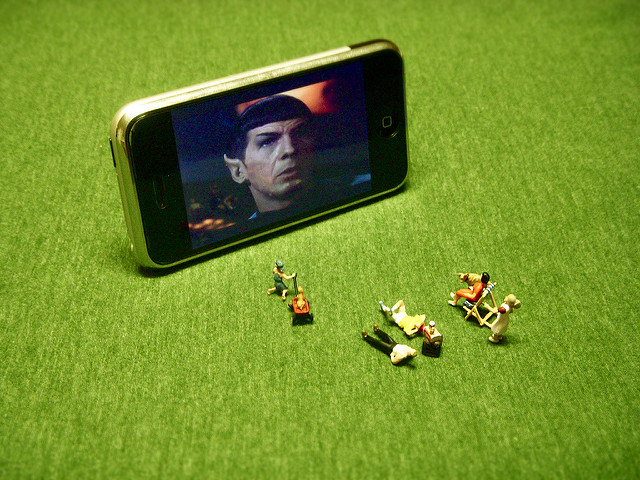
Image of Spock being watched is courtesy of Flickr user JD Hancock under a CC BY 2.0 license.

Monday, 11 August 2014

The CopyKat goes ape

In its submission to the US Department Of Justice's review of collective licensing in America, music collecting society BMI has said that it believes that music publishers should be allowed to choose which rights they allow it to administer.  It also says that BMI should be able to represent all rights in a musical work, including the mechanical right, not just the performing right, in order to create a "one-stop" licensing option and wats to see a new way for royalty rate disputes to be resolved. Just twenty four hours later the other big US song collection society ASCAP echoed those proposals, saying that allowing its members to pick and choose which specific performing rights it handed over to the collecting society to administer was "necessary to hold the system together". It also argued that being able to license mechanical as well as performing rights is "something that ASCAP's competitors are already free to do".

The BBC reports that the City of London Police's IP crime unit (PIPCU), which has been targetting web-block circumventing proxies, have now forced a number of these proxies offline and that one man has reportedly been arrested in connection with running a proxy server.


Sofie Gråbøl in The Killing
Sarah Lund, the star of the Scandanavian hot TV detective series The Killing, did an awful lot to promote chunky jumpers - the sweaters worn by actress Sofie Gråbøl became almost as famous as the cast of the Danish drama and Gråbøl admitted that her character had become dependent on her jumper and plans to scrap the woollen bound image were themselves scrapped by TV bosses. The show also prompted huge demand for the distinctive design - and now a lawsuit. The Faroese designers of Lund's original sweater, Gudrun & Gudrun, took legal action against Danish company Stof og Sy, which had made a considerably less expensive version of the "Lund" sweater - albeit one you had to knit yourself - retailing at 372 kroner (£40) rather than 2,887.50 kroner (£310) for a Gudrun sweater. But the claim for copyright infringement has failed - with a Horsens court in Denmark deciding that Stof og Sy can continue selling jumpers that resemble those from the acclaimed television series after Stof og Sy convinced the court that the star pattern used on the Lund jumper is an ancient and traditional Faroe Isles pattern - and the design of the jumper itself is based on the Faroese fisherman's sweater - both and hundreds of years old - so no violation of any copyright (or marketing laws) had taken place. More here and here. 

The Nigerian Copyright Commission (NCC) said it had seized pirated books, worth over N10 million, after a raid of markets and book shops, the Mile I Market and His Grace Bible House, Rumuowuta, all in Port Harcourt. The Commission disclosed that it has impounded 19 containers, suspected to be loaded with pirated books, at seaports and borders across the country. 

The U.S. Court of Appeals for the Sixth Circuit has confirmed that a party claiming infringement of copyrighted computer software must identify those components of the software that are protectable under copyright law before a jury can determine the substantial similarity of the defendant’s software.  Automated Solutions Corporation v. Paragon Data Systems, Inc., Case No. 12-3025; -3058 (6th Cir., June 25, 2014) (Cleland, J., sitting by designation). More here at the National Law Review website.

Re/Code reports that videogame streaming site Twitch's announcement that videos in its archives with unlicensed music will be flagged and partially muted has been met with some consternation and anger by users: Twitch has now admitted that it “screwed up” the announcement and has promised to add an “appeal” button for music that users think was flagged in error. But the actual act of cracking down on that unlicensed music, a seemingly necessary move to "avoid trouble from the litigious music industry", is here to stay.


Ronald Reagan: Official Portrait, 1981
Author Craig Shirely, an expert on former US president Ronald Reagan, is threatening to sue another author and biographer, Rick Perlstein, for copyright infringement for  his new Reagan book, The Invisible Bridge, seeking that the publisher of Perlstein's book pulp all copies, pay $25 million in damages, and take out adverts apologising to Shirley in The New York Times, The Washington Post, Newsweek, The Nation, The New Republic, Slate, and Salon. TechDirt suggests that Shiley's claim is rather unfounded saying "what he does have is the ability to point out where Perlstein relayed the same facts Shirley had previously recounted and a few minor sections which use Shirley's previous work as source material and paraphrase it. There are a couple of rather specific words retained in the paraphrasing, but that's about it, and most of those sections are recounting a setting or happening in history" adding "And it's not as though Perlstein is attempting to hide his use of Shirley's books as source material. The book-in-print directs those interested in the source material to Perlstein's website where he lists them out, including several of Shirley's books. He further credits Shirley's work in his source notes, talking about how useful it was. He further had reached out to Shirley to discuss some of his sources earlier.". Expect quills at dawn. 

Music Publisher EMI  has asked the Second Circuit to affirm it's victory in the battle with the heirs of songwriter John Frederick Coots over the ownership of the copyright in the song "Santa Claus Is Comin' to Town," asking the appellate court to confirm the lower court decision that company owns the song's rights until 2029. In a brief to the appeals court, EMI urged the Second Circuit to uphold U.S. District Judge Shira Scheindlin's ruling that Coots' heirs couldn't use the termination provisions under the Copyright Act of 1976 to regain the rights.


One of the disputed 'selfies'
Over on the IPKat Jeremy has posted a guest blog from Estelle Derclaye which re-examines the Case of the Black Macaque - the dispute between Wikipedia and British phorographer David Slater about some monkey business.- the snaps taken when the photographer's camera was stolen by a monkey (a crested black macaque) while he was on a trip to Indonesia in 2011 - and the monkey took a few shots of herself. Back in 2011 Aurelia J. Schultz posted an article on the 1709 Blog looking at this from the perspective of UK law and Indonesian law - as that is where the photo was taken - and the Daily Mail published the pictures here in the UK and online - and one of the thtee published 'selfies' had (C) Caters News Agency embedded in the shot with Mr Slater explaining "One of them must have accidentally knocked the camera and set it off because the sound caused a bit of a frenzy" and "At first there was a lot of grimacing with their teeth showing because it was probably the first time they had ever seen a reflection. They were quite mischievous jumping all over my equipment, and it looked like they were already posing for the camera when one hit the button. The sound got his attention and he kept pressing it". There is no mention of Slater amending the shot at that time although the three shots do look beautifully positioned and cropped in the Mail. Aurelia's opinion on the then known facts - "it appears under UK law, the photos are in the public domain. Under Indonesian law, the matter is less clear."  Slater is now looking to have the photos removed from Wikipedia: Wikipedia believes that although the photos were taken on the photographer's camera, he does not own the copyright because he did not take the photos. The Wikimedia Foundation spokeswoman, Katherine Maher, said that under US law no one owns the copyright and a message on its site states: "This file is in the public domain because as the work of a non-human animal, it has no human author in whom copyright is vested." Slater believes that Wikipedia's refusal to remove the article and a link to a free download of the images has negatively effected his livelihood and earnings. Estelle's view - "So is there copyright in the photograph? It seems
like this will be an evidential issue. If the photographer did indeed adjust the camera settings and the monkey stole the camera, then the monkey just pressed a button and is not the author, but the photographer is" and asks whether amendments such as cropping can "qualify the photograph as a derivative work made by the photographer?" concluding
 "The photographer may have a case -- and he actually wants a court to decide the issue." There were ten comments last time I looked - a couple of which are well worth a read. And with all this monkeying about, why not take a look at Eleonora's blog on the infamous 'Oscars' selfie - another copyright conundrum - but this one caused by actors rather than apes! And here's what hapens when you put a camera amongst a pride of lions ........ something that actors would NEVER do! And an interesting blog on this from Andrew Charlesworth, Reader in IT & Law at the University of Bristol, looking at both the concept of who can be a person and who might own the copyrights - and which jurisdiciton might apply here - and from an Australian perspective (what if a Koala took the selfie) see much more here.


That Oscars selfie and an automated snap of lions
And finally (and as you enjoy these various selfies) the CopyKat came accross a rather well written article about "common copyright myths related to fan fiction". The blog, A Fresh Look at Copyright and Fan Fiction by non lawyer Deb McAlister-Holland was actually an update of an earlier blog about fan ficiton and the author had been contacted by attorney Heidi Tandy who then helped McAlister-Holland through this tricky area - recently thrust into the public eye with Conan Doyle Estate's unsuccessful attempt to protect an expired copyright in many of the Sherlock Holmes stories and the characters of Holmes and Dr Watson. This new article is a good read and looks at transformative works under US law, The Supreme Court's decision in Campbell v. Acuff-Rose Music, the "Harry Potter Lexicon" case, and commercial and non-commercial uses in the USA in the context of fan fiction. If you have a burning urge to write the next sequel or prequel to Lord of the Rings, or deveop your own 'Harry Potter' characters or bring new tales of vampiric delight with your own Twlighight Saga you can find the original article here and the updated article here.

Saturday, 24 May 2014

Is Disney thawing in the public glare of fan fiction?

It seems that Disney may be softening it's approach to perceived copyright infringements in the form of user generated content and fan fiction and other fan created content. A number of bloggers have noticed that people from all over the world have taken copyrighted content from “Frozen”, Disney's hit animated movie, including the infectious song “Let It Go” and have uploaded content onto YouTube and other social media - postings that undoubtedly infringe Disney’s intellectual property - fair use or no fair use. 

On YouTube, you can find versions of “Let It Go” that are sing-alongs, mashups, covers and parodies. Some of these videos have "racked up millions of pageviews". But it seems that there has been a shift at Disney -  rather than viewing the postings as mass piracy - Disney has let it stand with no known DCMA takedowns. Interestingly, one blogger noted that Disney’s own efforts to establish an online presence has thus far only had a lukewarm reception - until the company recently purchased Maker Studios, a company that produces YouTube videos, tapping into amateur creators to provide content and it maybe that Disney has accepted the popularity of fan-created content - as a way to expand the brand and engage fans. That said - Disney’s position on copyright infringement won't have softened completely. Whilst Disney may well be aware of the anecdotal evidence that the same people who are buying soundtracks and merchandise and DVDs for Disney movies are the same people who are making and sharing YouTube videos - the company has always battled to protect (and extend) it's copyrights - from Mickey Mouse to Bambi, From the Little Mermaid to Beauty and The Beast - and indeed just after the cinema release of Frozen the company took immediate legal action when Phase 4 Films changed the name of one of it's own films, The Legend of Sarila,  to Frozen Land, seemingly repackaging their DVD release with some rather similar artwork along with a new logo and new promotional material - to allegedly mimic Disney's movie - and Disney say this:

The Walt Disney Company and its subsidiaries own the intellectual property rights to the characters, brands, titles and properties popularly associated with the Disney name and with Disney's affiliates. This includes a large number of titles, characters and other elements from Disney's television programs, feature-length motion pictures, animated productions, publications, games and music.

Disney takes the enforcement of these rights very seriously. We protect these rights so that we can continue to provide quality entertainment that measures up to the standards that our audience has come to love and expect. We welcome reports of suspected infringement of any of these rights. Please direct reports to us via one of the following methods:

More here http://blogs.findlaw.com/celebrity_justice/2013/12/disneys-frozen-lawsuit-claims-trademark-infringement.html