Showing posts with label publishers. Show all posts

Tuesday, 13 December 2016

Academic publishing houses lose appeal against Delhi University & photocopy shop

We are reposting this excellent article by Prashant Reddy (details at the end of the post) first published on the IPKat

Academic publishing houses, OUP and CUP have suffered yet another defeat in their litigation against Delhi University and a photocopy shop when a Division Bench of the Delhi High Court ruled against them in an appeal on December 9, 2016.

The crux of the lawsuit was whether the practice of photocopying copyrighted material and compiling them in course-packs was copyright infringement under Indian law. Given that universities and students have been photocopying copyrighted material for several years without any restrictions, the lawsuit had provoked an angry backlash from students and academics – both of whom then organised themselves into an association and intervened in the case. 

The first round of litigation ended in an emphatic defeat for the publishers when a Single Judge of the Delhi High Court dismissed the lawsuit on 16th September, without conducting a trial, on the grounds that photocopying for educational use was covered under Section 52(1)(i) of the Copyright Act, 1957. This provision states that the following acts shall not be considered as an infringement of copyright:
“the reproduction of any work—(i) by a teacher or a pupil in the course of instruction”.
The end goal of the publishers was to introduce a licensing system in Indian universities and charge them a royalty for photocopying copyrighted material that were compiled into course packs. 

The second round of litigation began with an appeal filed by the publishers before a Division Bench of the Delhi High Court. In its judgment the Division Bench set aside the judgment of the Single Judge and remanded the matter for trial on two issues. 

Quantitative and Qualitative restrictions on photocopying for the purpose of instruction

On the point of law however the Division Bench has broadly concurred with the Single Judge and has ruled that the language of Section 52(1)(i) does not impose any quantitative or qualitative restrictions when a work is being used for educational purposes. According to the Division Bench, the only issue to be determined while claiming this exception under Section 52(1)(i) is whether the “inclusion of the copyrighted work in the course-pack was justified by the purpose of the course-pack”. As per the court this was an issue to be determined at trial with expert evidence although as far as I know there was no factual dispute on this issue of the course packs being relevant to the course. It is not clear how a judge is going to decide the relevance of readings to a particular course since that’s the teacher’s prerogative – what one teacher may consider relevant another may not.

The second issue remanded for trial was whether the photocopying of entire textbooks was permissible since apart from the course-packs, the photocopying shop was also found to be photocopying entire textbooks. However given the court’s ruling that there are no quantitative restrictions on photocopying under Section 52(1)(i), the photocopying shop merely has to argue that the textbooks were being photocopied by students as a part of their course-work. 

Photocopying through an agent 

On the issue of whether Section 52(1)(i) allows for reproduction only in the classroom or whether it can be extended to photocopying through an external photocopier, the court ruled against the publishers. The publishers had tried arguing that the provision had to be confined to classroom teaching and external photocopying done through the Rameshwari photocopy shop would not be covered. The court however disagreed, stating that the core issue was reproduction of a work through photocopying. The issue of photocopying through an agency was thus deemed “irrelevant” by the court.

Liability of Delhi University for the actions of the photocopier shop

A secondary issue in this case was Delhi University’s liability for the acts of Rameshwari photocopying shop. Rather than dismiss this claim on the grounds that copyright infringement had not been established, the court dismissed this claim on the grounds that the University had no role to play since the academic council’s action was restricted to setting the course curriculum leaving it to the teachers to decide the reading material. It appears that the Court completely failed to understand the issue at hand because teachers are still employees of the University and the issue at question was one of knowledge regarding the actions of the photocopying shop i.e. was the University aware of the actions of the photocopy shop? 

8% of book or an entire work: How much exactly was being photocopied? 

One of the key problems with the publisher’s strategy in this case is that they presented the material being photocopied in terms of percentage of each book from which the material was taken. For example before the Single Judge they argued that quantities of copyrighted books copied ranged from 8% to 33%, while the Division Bench calculated that on average 8% had been copied from the 23 books that were at dispute. These calculations are incorrect because most of the 23 books in question were compilation of essays or articles by different authors on a similar theme. In such cases, each essay or article is counted as an individual copyrighted work under the law. Therefore when one essay or article is photocopied from one book for inclusion in a course-pack, an entire copyrighted work is being reproduced. 

Framing the argument in terms of percentage of a book weakened the case of the publishers especially when they were trying to argue that a ‘substantial part’ of each book was being photocopied. The phrase ‘substantial part’ is found in Section 14 of the Copyright Act which explains that a copyright authorises the owner of a copyright to control the use of a work or ‘substantial part’ of a work. 

Foreign precedent and Indian copyright law 

One of the many perils of being a former colony of the UK is our over-reliance on foreign legal precedent, often without understanding the context. The danger of this approach cannot be overstated in the context of copyright law. The Indian Copyright Act, 1957 is fundamentally different from most common law jurisdictions because of its heavy reliance on compulsory licensing after the Paris Revision of the Berne Convention in 1971 – these CL provisions are absent from the copyright legislation of most common law jurisdictions, especially developed countries like the US and UK.

Similarly on the issue of exceptions and limitations under Section 52, we have some provisions which use the phrase ‘fair dealing’ and several others omit the phrase ‘fair dealing’ giving them the flavour of complete exceptions. Given these unique characteristics of Indian copyright law it is necessary for the Indian bar and bench to be careful while using foreign terminology or case law. Unfortunately that is not the case in India. 

The IP bar, especially at the Delhi High Court, indiscriminately cites foreign precedent in IP cases resulting in an IP jurisprudence that is a train-wreck. For example, some judges of the Delhi High Court have granted punitive damages in copyright and trademark cases by citing utterly irrelevant American judgments, when neither Indian copyright or trademark law provide for punitive damages.    
In the current photocopying case, the publishers apparently tried arguing in favour of reading in the American style four-factor ‘fair use’ analysis in order to convince the court to limit the quantity that could be copied under Section 52(1)(i). This is a surprising line of argument because copyright owners are usually terrified of the American style fair use analysis due to the high degree of discretion left to judges. Clearly the publishers arguing this case thought otherwise and maybe Indian lawmakers should consider incorporating such an exception into the Indian statute. 

Although the Division Bench rejected the publisher’s argument on the American style fair use exception and also expressed caution against relying on foreign case law, it thought nothing of devoting reams of pages in its judgment towards discussing an old copyright case from New Zealand because the provision at dispute in that case was similar (not identical) to Section 52(1)(i). However the context of New Zealand’s copyright law is entirely different from Indian copyright law since the former has never had the equivalent of Section 32A of the Indian Copyright Act – which is a wide ranging compulsory licensing provision introduced in 1983 for the purpose of making available copyrighted works for educational purposes at a reasonable price. 

As I argued in an earlier post on IPKat, a wide reading of Section 52(1)(i) results in providing a carte blanche for reproducing copyrighted material for educational uses and would render Section 32A redundant – the principles of statutory interpretation require judges to reconcile apparent conflicts in a harmonious manner. It is impermissible to interpret one provision in a manner which renders another provision of the same law redundant. For whatever reasons, the publishers did not take this line of argument before the Delhi High Court. 

The writer is co-author of a forthcoming book to be published by OUP – Create, Copy, Disrupt: India’s Intellectual Property Dilemmas (with Sumathi Chandrashekaran) and is a Research Associate at ARCIALA, School of Law, Singapore Management University.   

Saturday, 10 December 2016

The CEIPI Publishes An Opinion on the EU Commission’s Copyright Reform Proposal


The Center for International Intellectual Property Studies (CEIPI) which is part of my alma mater, the University of Strasbourg, published on November 28, 2016 its Opinion on the European Commission’s copyright reform proposal (the Opinion). The Opinion, which was written by Professor Christophe Geiger, PhD candidate Oleksandr Bulayenko, and Senior Researcher Giancarlo Frosio, focuses on the introduction of neighbouring rights for press publishers in EU law. It argues that the recent Directive proposal would make it harder to reach the Digital Single market. The authors of the Opinion conclude by recommending “to refrain from advancing this legislative action.” The CEIPI sent its Opinion to the EU Commission on December 2.


What Are the Commission’s Proposals re Neighbouring Rignts??

The Commission adopted in May 2015 its Digital Single Market Strategy, which goal is to reduce the differences between the copyright regimes of the Member States and to allow works to be widely accessed online across the EU.

Following a consultation on the role of publishers in the copyright value chain, which the European Commission had launched on March 23, 2016, the Commission introduced on September 14, 2016 its Proposal for a Directive of the European Parliament and of the Council on Copyright in the Digital Single Market (the Proposal).

The Opinion concentrates on the neighboring rights that the Proposal would give to publishers. The Impact Assessment on the modernization of EU copyright rules, also published by the Commission on September 14, provides a helpful overview of the rights provided to the publishers in various member States (see Part 3/3, p. 189-192).

The Opinion cites the example of the German law on Authors’ and Neighbouring Rights which gives some exclusive neighbouring rights to press publishers, such as making available for commercial purpose any publications and parts thereof. This, as noted in the Opinion, takes “only individual words or the smallest text excerpts” out of the scope of the law (Opinion p. 6). A Spanish law provides press publishers the right to be remunerated for making available online non-significant fragments of their publications. The Opinion notes that the legality of this right has been questioned, for example here (Opinion p. 6).

The Opinion notes that they are tensions between press publishers and online service providers in several countries, Belgium, France and Italy. Such tensions have been addressed by signing agreements, not by enacting new laws. For instance, a financial fund financed by Google has been put in place in France. It is intended to provide financial support for projects of publishers of political and general information sites. A similar Italian fund is also financed by Google, which also finances the EU Digital News Initiative (Opinion p. 7).

Article 11(1) of the Proposal directs Member States to provide publishers of press publications with the neighboring rights provided for in Article 2 and Article 3(2) of Directive 2001/29/EC for the digital use of their press publications. This means that the “publisher’s neignboring rights would encompass the right of reproduction and making available to the public for digital uses” (Opinion p. 11).

Under Article 12 of the Proposal, Member States could provide a publisher, to whom an author has transferred or licensed a right, the right to share the compensation for the uses of the work made under an exception or limitation to the transferred or licensed right.

The authors of the Opinion note that the combination of these two articles may give publishers two revenue streams, if both copyright and neighboring rights have the same exceptions and limitations: the publishers would receive a revenue both as holders of the neighbouring rights  and as transferees or licensees of authors’rights (Opinion p. 12).

The Proposal Would Make it Harder to Reach the Digital Single Market

Member States have each their own copyright and neighbouring rights laws. The Opinion states that:

“the Impact Assessment fails to explain how an additional layer of 28 national rights might promote the Digital Single Market. Rather the proposal poses further challenges related to the territoriality of rights and their fragmentation” (Opinion p. 8).

This is a concern, especially since the Proposal “does not pre-empt the re-emergence of new national legislation extending rights of press publishers. Member States still remain free to create other neighbouring rights in their national law” (Opinion p. 8). The authors point out that our own Eleonora Rosati has questioned the lawfulness under EU law of allowing Member States to create neighbouring rights.

The authors of the Opinion are also concerned by the facts that the exceptions and limitations to authors’ rights, which are currently applicable to those rights in the Member States, may not be equally applied to the neighbouring rights. For instance, national laws could regulate differently when and if such exceptions can be overridden by contract or technical protection measures (Opinion p. 9).

Allowing Member States to each create their own neighboring rights and even expanding them could fragmentize the Digital Single Market, and thus hurt it. The authors of the Opinion advocate instead for the enactment of a unitary right (Opinion p. 9).

Proposal Would Reduce the Economic Value of Creative Works

The authors of the Opinion argue that if more economic actors can share the revenues of creative activities, the authors may lose part of their revenue, as the financial pie is not getting bigger even while more guests are invited to partake. The “pie theory” explains that “new royalties stemming from neighbouring rights are going to be distributed at the expense of those receiving royalties from authors rights today” (Opinion p. 11, citing this recent article by Joseph Pomianowski).


There is a chance that publishers from other sectors than the press, such as music publishers, would request neighbouring rights, which could further reduce authors’revenue (Opinion p. 9). Granting rights to more actors “will decrease the economic value of each rights” (Opinion p. 10). However, the “pie” is not getting bigger (Opinion p. 12).

No Causal Link Between Publishers’ Revenues and Granting them Neighbouring Rights

Publishers generally hold the economic rights of authors, under various legal schemes, such as contract or work for hire (Opinion p. 13). Not every publisher believes it must have neighboring rights, and some have even argued that they are not necessary. Even if publishers are sometimes called into court if a work has been infringed, granting them neighbouring rights “will not change the burden of proof for proving ownership of authors’ rights in court” (Opinion p. 14). For these reasons, there is no “causal link supporting the introduction of new rights” (Opinion p. 14).

The Scope of Protection is Overbroad

The authors of the Opinion are troubled by the fact that the Proposal “does not limit the subject matter to works and uses presently protected by authors’ rights.” Even unoriginal works could be protected by neighbouring rights (Opinion p. 16). Works from the public domain could be protected as well, and works published under a public copyright licenses could be restricted by such rights (Opinion p. 17). Restricting the public’s use of works in the public domain “imping[es] greatly on freedom of expression and democratization.” This would have repercussions on the ability of people of lesser means to disseminate their speech and would instead favor big corporations (Opinion p.17). The Authors also argue that the proposed term of protection, 20 years, is “way too long” (Opinion p. 18). 

The authors conclude that introducing neighbouring rights for press publishers will create new EU copyright issues instead of solving them.

The Opinion is a very interesting read, and this is both my impartial blogger opinion and my hometown partial Alsatian opinion.


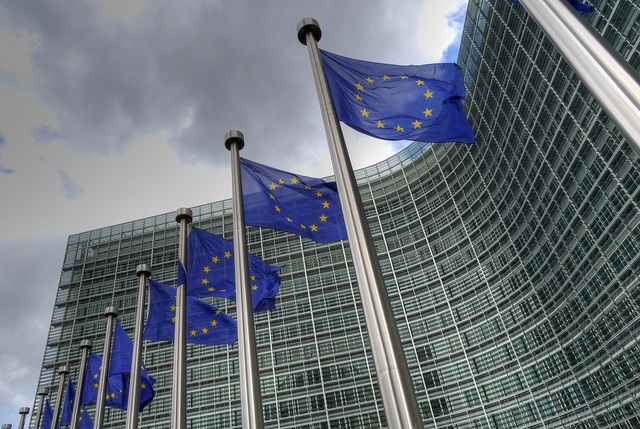
European Commission Image is courtesy of Flickr user Kevin White under a CC BY-NC-ND 2.0 license.

Tuesday, 6 March 2012

New neighbouring right to be introduced in Germany

The German coalition government has decided to create a new neighbouring right for newspaper publishers. In the future, commercial Internet service providers, such as search engine providers and news aggregators, shall pay an equitable remuneration to publishers for the use of media products such as newspaper articles. The move is supposed to ensure that publishers receive a share in the profits (mainly advertising revenue) that commercial internet service providers make from exploiting the publishers' products. Remembering that the pet child of German copyright law is the author rather than the publisher, the resolution goes on to state that authors shall also partake in the benefits of the new neighbouring right and receive an equitable share in the proceeds.

In an attempt to quell opposition against the proposal, the coalition has emphasised that the mere consumption of media products - looking up an article via Google News and reading it online, say - will not be affected by the proposed new law. This goes not only for private individuals, but for companies, etc as well.

In addition, the new neighbouring right is envisaged to be of a surprisingly and perhaps refreshingly short duration: only one year (presumably from the date of first publication).

The coalition does not seem too sure how the equitable remuneration for publishers and/or authors should be calculated, but trusts in the expertise of German collecting societies. It is likely that one of the existing collecting societies (my money is on VG Wort) will take over the administrative side of things.

Will the bus driver have to pay?
It will not come as a shock to you, dear readers, that the reactions to the proposed new law have been mixed. Depending on whom you ask, it's the best thing since sliced bread, a tentative step in the right direction, a subsidy for big publishing houses that will not benefit journalists in any way whatsoever, or a compulsory levy that unjustly favours one particular business sector. Journalist Stefan Niggemeier quipped (here): "It's as if the yellow pages had to pay companies for listing them. As if the bus driver had to pay the fun-fair operator for bringing him customers. The proposal lacks any kind of inherent logic."

So what do you think? Is the new neighbouring right a good thing or a really bad idea?


Report in the Frankfurter Allgemeine Zeitung here
Report on heise.de here, which also contains a link to the resolution (which deals with a number of other things, too; the copyright bit is on page 4)

Wednesday, 28 September 2011

Academics v Publishers: Revolution in the air?

Following George Monbiot's scathing article in the Guardian last month, the subject of academic publishing has been weighed and been found wanting. Of course, librarians and academics have long known that journal publishers monopolise the market; even as much as ten years ago the larger publishers were busy buying out the smaller ones who weren't strong enough to compete with them. But outside of academia people are largely unaware of the struggles every electronic resources librarian faces each year as budgets shrink and journal bundle prices steadily increase. Tough decisions often have to be made, and naturally the impact is felt by researchers, academics and students.

Which is why today's announcement that Princeton University is enforcing an Open Access policy forbidding academics from transferring the copyright in their articles to journal publishers is so significant. Academics are required to licence their work instead, so that they retain the copyright and are therefore able to reproduce it elsewhere without having to seek the permission of the publisher. This could spark a welcome trend which would allow academics and universities to maximise their outputs and revolutionise knowledge sharing.

Certainly in the UK, where most universities now have institutional repositories which host research outputs (scholarly articles written by their academics), this trend would be welcome and would resolve numerous difficulties in attempting to interpret publisher policies. Part of the problem is that academics are often unaware of the terms they agree to when they sign a Copyright Transfer Agreement (for an example see here). Yet even when they are aware, academics often don't have time to negotiate licence agreements with publishers as they are under pressure from their institution and/or funding body to publish. Most of the larger publishers either do not allow a version to be deposited in the repository or are very specific about the version which can be deposited, and attempting to contact publishers for permission is usually incredibly difficult if not impossible. And whilst organisations such as SHERPA/RoMEO provide a useful source of information on publisher policies, policies are changing all the time and it is difficult to maintain up-to-date records. Recent woes include publishers moving to automated systems which invoice funding bodies and universities directly for open access; these sorts of issues cause headaches for repository managers and copyright officers alike.

This is is not to decry the value of academic publishing, and indeed it has been interesting to read reactionary pieces and comments to the Monbiot article (including from the publishers themselves) which indicate moves afoot in the publishing world. But what is increasingly obvious is that the current mainstream system cannot continue forever; something's got to give, and one wonders whether Princeton has just thrown down the gauntlet to universities everywhere...

Photo from Flickr: Princeton University by Yakinodi (CC-BY 2.0)