Showing posts with label oscars. Show all posts

Tuesday, 27 February 2018

I thought I saw a COPYKAT ..........


The US Federal Court in New York ruled that it is possible to infringe the copyright by a simple action of embedding a tweet on a website. The case concerned a photo of Tom Brady (New England Patriots quarterback) with Boston Celtics’ General Manager Danny Ainge, which was taken by Justin Goldman and posted on his Snapchat. Shortly thereafter, the photo went viral and was uploaded by a number of users on Twitter. Since the story was newsworthy, a number of news organisations have embedded the link to these tweets on their websites. Goldman has filed a lawsuit against a number of online publications including Yahoo, Time and the Boston Globe for violating his exclusive right to display.


Following the 9th Circuit case Perfect 10 v Amazon, the general position of the US courts has been that the copyright liability rests with the entity that hosts the content that is infringing copyright on its server (the so-called ‘Server Test’), and not the party who links to that material.  According to 17 U.S. Code § 106(5) the author has the exclusive right to ‘display the copyright work publicly’.  Judge Forrest in her summary judgment has rejected the Server Test by saying that “when defendants caused the embedded Tweets to appear on their websites, their actions violated plaintiff’s exclusive display right; the fact that the image was hosted on a server owned and operated by an unrelated third party (Twitter) does not shield them from this result”. Additionally, she noted that the Copyright Act does not suggest that “possession of an image is necessary in order to display it. Indeed, the purpose and language of the Act support the opposite view”.

This decision, together with the potential appeal, is important for all producers of digital content. According to Defendants the Court’s ruling may “cause a tremendous chilling effect on the core functionality of the web”. On the other hand, the judge has observed that there are some questions whether publication of a photo on Snapchat means that the copyrighted work is effectively released into the public domain.


Following the last year’s petition the US Copyright Office is looking at the introduction of the exemption that would ease current Digital Millennium Copyright Act (DMCA) anti-circumvention provisions (renewed every 3 years) in relation to preservation of abandoned video games. Previously, museums, libraries and archives were able to preserve abandoned games by having a right to use emulators and other circumvention tools to make old games playable and keep them accessible. Now, several organisations, including non-profit Museum of Art and Digital Entertainment (MADE) requested for an additional exemption that will allow preservation of online video games. There is a big number of MMPORGs (Massively multiplayer online role-playing games) such as Star Wars Galaxies or City of Heroes, where copyright owners have decided shut down their servers and games cannot be played online anymore.  

On the other hand, major game publishers such as Electronic Arts, Nintendo and Ubisoft have asked the US Copyright Office not to create such exemption. The companies, represented by Entertainment Software Association (ESA), have opposed the proposed changes with a view that such exemption will allow other users to “recreate online game environments using server code that was never published in public”. This may allow ‘affiliates’ to replicate the game and allow everyone in the public to play them, activity for which the companies were previously charging their users. Additionally, as observed by ESA, MADE already charges the general public for the access to the museum, where the users can play the games for the whole day for a fee of $10. The Association says that “public performance and display of copyrighted works to generate entrance fee revenue is a commercial use”, within the meaning of Section 107 “even if undertaken by a non-profit museum”. With a growing market and popularity of retro video games, the US Copyright Office will have to consider arguments of both sides and decide whether to introduce this exemption.
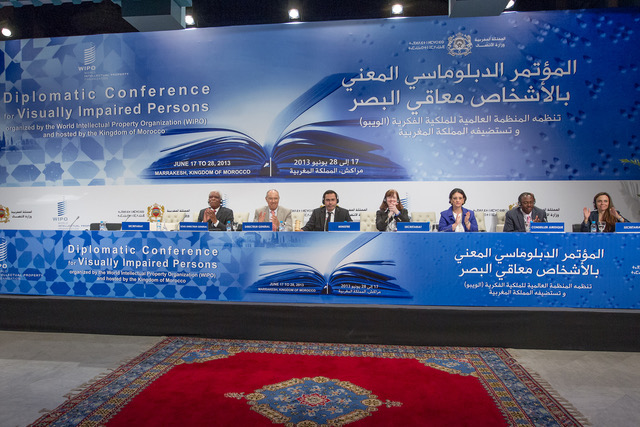

The Council of the European Union, 12 months after the decision of CJEU that the European Commission had an exclusive competence to conclude agreements which affect common rules already in place (here European Copyright legislation), has adopted a decision to approve the ratification of the Marrakesh Treaty.

The Marrakesh Treaty to facilitate access to published works for persons who are blind, visually impaired, or otherwise print disabled, administered by WIPO, entered into force in September 2016. The agreement provides for set of international rules that ensure exceptions in the copyright law so that “blind and visually-impaired people (VIPs) can access cultural materials like books without hindrance” and governs cross-border exchanges. As an effect the publishers can lawfully reproduce materials in a format accessible for VIPs without the fear of being sued for copyright infringement. Following the ratification of the Treaty by the EU later this year, the Member States will be required to introduce adequate exception into their own national laws.


Since the Pirate Bay saga (more on it here) the prosecutors in Sweden have called for a tougher approach towards serious breaches of copyright law. The Swedish penalties comparing to those on the international level were considered to be low. Therefore, the Council of Justice in its report has proposed legislative changes that would create new criminal classification and crime divided into two levels, depending on its seriousness.

At the first level “[a] person who has been found guilty of copyright infringement or trademark infringement of a normal grade may be sentenced to fines or imprisonment up to a maximum of two years.” Whereas, in the case of large-scale infringement “a person may be convicted of gross copyright infringement or gross trademark infringement and sent to prison for at least six months and not more than six years”. To assess whether the crime was of ‘gross’ degree, under the new proposal the courts will take into account the amount of damage caused to the rightsholders, as well as any monetary gain made by the defendants.

The proposal also envisages the possibility of seizing property, either physical or intangible, such as domain names. As reported by TorrentFreak “’[t]his proposal is a clear nod towards the Pirate Bay case which dragged on for several years before the state was able to take over its thepiratebay.se domain”.

The proposed date for the amendments to enter into force is 1 July 2019.


Having recently observed a number of calls in Australia to reform its current copyright law framework and make it more suitable in the age of digital technologies, our attention turns now to New Zealand. Here, in June 2017 the Government has launched a review of Copyright Act 1994 to ensure that the “copyright regime is fit for purpose in today’s rapidly changing technological environment”. Recently, InternetNZ (a non-profit organisation) has launched a position paper, in which it seeks to update the copyright law framework and achieve a modern balance. As noted by the organisation, each new technology for copying that was introduced in the past years with the use of the internet (such as data and text mining, cloud computing), has been blocked due to lack of technology neutral exceptions to the copyright. InternetNZ CEO, Jordan Carter says that “the Internet has opened up new opportunities for creative New Zealanders”. Nevertheless, at the same time, uses of technology like cloud back-ups are likely to infringe copyright. Hence, in the view of InternetNZ, the new reform should introduce a more flexible open-ended ‘fair use’ style exceptions that will enable predictability in the use of copying technologies based on the ‘fairness’ test. The authors of the report suggest that the reform of copyright framework should aim to find a modern balance that will allow “the full benefits of both modern technology and local creativity”.


The US District Judge Michael Fitzgerald dismissed the action in the lawsuit brought by 3LW against Taylor Swift for stealing lyrics for the chorus of her song ‘Shake It Off’. The songwriters in their copyright infringement action claimed that the Taylor Swift’s song was based on the phrase "players, they gonna play, and haters, they gonna hate”, which was used in the song "Playas Gon' Play" by R&B girl group 3LW in 2001, and that combining those two ideas was original enough for the protection.

According to the Judge the lyrics in order to be protected by copyright must be more creative. He wrote that “the allegedly infringed lyrics are short phrases that lack the modicum of originality and creativity required for copyright protection”. In his view “combining two truisms about playas and haters, both well-worn notions as of 2001, is simply not enough”. He added that “the lyrics at issue (...) are too brief, unoriginal, and uncreative to warrant protection under the Copyright Act”. The songwriters were given the opportunity to file an amended lawsuit, however, as reported by CNBC, the attorney for songwriters would appeal Fitzgerald’s ruling to the 9th US Circuit Court of Appeals.


With only few days left before the 90th Academy Awards ceremony, amid the voting of the Academy, authors of ‘The Shape of Water’, Guillermo del Toro and Fox Searchlight were sued for allegedly copying the idea for their film.  According to the family of the late Pulitzer Prize-winning author Paul Zindel, the story of inter-species love has copied a number of copyright protectable literary elements from the plot of ‘Let Me Hear You Whisper’ play. The play as described by Daniel Zindel “also depicted a lonely cleaning woman who works at a lab, bonds with an aquatic creature and breaks him out after learning authorities planned to kill him”. 

Del Toro explained that the story of the film “and the layers are completely and entirely complex, interwoven with Russian spies, the Cold War, female friendships that are so complex and more important than that, which are completely original”. The lawsuit for copyright infringement came after the film has received 2 Golden Globe Awards and 13 nominations for the Academy Awards. Fox Searchlight in its statement said that the claims brought against them are “baseless, wholly without merit” and with a view to pressure the studio to quickly settle.  


Professor Jessica Litman
On 13th March 2018, the Centre for Intellectual Property and Information Law (CIPIL) is holding its Annual International Intellectual Property Lecture at Emmanuel College, Cambridge. In this year’s lecture Professor Jessica Litman, John F. Nickoll Professor of Law at University of Michigan Law School, will argue that when we think about the copyright system, our assumptions about legal property rights shape what we see and what we don’t. We assume that broadening or narrowing the scope of copyright will redound to the benefit or detriment of creators. Three hundred years of evidence, though, belie that supposition. We need to think more concretely about copyright law's actual effect on creators, and their ability to communicate and profit from their works.

This is an invitation-only event which will take place on Tuesday 13th March 2018 at 5:30pm. If you would like an invitation, or for further information, please contact CIPIL Administrator, Mr. James Parish cipil@law.cam.ac.uk

This CopyKat by Matt  Rachubka

Monday, 23 February 2015

The CopyKat - trolling tonight

Freeplay, the US-based library music company, which has been providing music for bedroom filmmakers for their YouTube videos, has filed litigation against four 'multi-channel networks', accusing the the firms of abusing licences they had designed for user-generated videos to circumvent having to pay for the music used in their commercial content. The companies being sued include some of the big guns in the growing MCN space: Disney's Maker Studios, DreamWorks Animation's Awesomeness, Big Frame and BroadbandTV Corp. Two more - Machinima and Collective Digital Studio - which launched pre-emptive strikes against Freeplay last week, are set to receive countersuits from the music rights owner in due course. Freeplay offers a licence to amateur video makers that allows them to use music from the Freeplay library free of charge, on the condition Freeplay is able to subsequently monetise that content on YouTube using Google's Content-ID system to collect ad revenues. But Freeplay charges commercial content producers $250 a year for a licence - and says that licence is designed for personal Youtube channels - NOT MCNS. Freeplay say they used the audio fingerprint technology TuneSat to locate their music on numerous MCN-operated channels all being used without the right licence. The lawsuits allege that Freeplay contacted the four MCNs about licensing the music, but that they were not willing to negotiate. The suits seek unspecified monetary damages and demand that the infringement cease. Machinima and Collective Digital Studio argue that Freeplay is deliberately confusing amatuer video makers into using the free sync music from Freeplay's libraries - only to be subsequently invoiced, or threatened with legal action when the usage is classified as commercial. The MCNs go as far call Freeplay's approach 'copyright trolling'. More on Variety here.

And more on alleged trolling - this tme its all about a Australian wine maker called Stephen Moignard who has designed an algorithm called Plfer to hunt down "substantially similar" text across multiple websites and serve demand letters to alleged copyright infringers. TechDirt is of the opinion that Plfer's detection algorithm bears many similarities to commercial plagiarism detection software, albeit with a few tweaks that allow it to bypass web formatting and other obstacles that might throw off comparisons. TechDirt also have some queries about Mr Moignard's maths and interpretation of the law - and all in all its a very interesting read, even for luddites like the CopyKat. The beta site for Plfer is here and the value of copyright infringements currently 'detected' is a whopping $1,413,463,665.

And finally on this: Two people targeted by one of Rightscorp's anti-piracy programmes in the U.S. say that the somewhat controversial company has violated America's Telephone Consumer Protection Act by sending them automated calls and text messages without permission. In a lawsuit filed with the federal court in Georgia, Melissa Brown and Ben Jenkins deny downloading any copyright infringing content, but say Rightscorp broke communication laws by following up an initial letter with calls and texts attempting to gain a settlement for alleged infringements.

The Daily Mail reports that a German historical society is set to publish an annotated edition of Hitler's controversial tome Mein Kampf after the book's copyright expires later this year. The Munich Institute for Contemporary History (IfZ) says it will publish a two-volume edition of the book in which the Nazi leader outlines his anti-Semitic beliefs and plans for world domination. The new volume will consist of a total of 2,000 pages. However just 780 of these will contain Hitler's original text - the rest will be comments from contributors and the work will also contain a new introduction and index. Copyright in the book is held by the State of Bavaria. In January 2012 the 1709 blog reported that the District Court of Munich I (LG München I) had issued a preliminary injunction on behalf of the Bavarian state government, prohibiting the planned publication of commented excerpts of Mein Kampf by British publisher Peter McGee because of the copyright. The injuction was subsequently upheld. Bavaria also indicated that Germany's anti-Nazi laws might be a bar publication - now more pertinent as copyright expires 70 years after Hitlers death in 1945.  In Decmnber 2013, reversing a pervious postion, The Bavarian governor's chief of staff, Christine Haderthauer, said the book amounted to incitement to hatred and the government would file criminal complaints if anyone tried to publish the book when the copyright expired.  In 2012 the then President of Germany's Central Council of Jews said he hoped that the reprints would ‘demystify" the book. "I'm an Internet junkie myself" he said. "Everyone can already find the book on the Web." However, an American Jewish group countered saying the publication plans could be morally offensive and last year Dieter Graumann, president of the Central Council of Jews in Germany, said that he was strongly opposed to the book going on sale. 

Vivian Maier - self portrait
The epic battle over who owns the copyright in the photography of Chicago nanny Vivian Maier has had a couple of new skirmishes, Maier, who had a 'secert life' as a photographer, snapped over 150,000 images in and around Chigago from the 1950s onwards. Maier made no attempt herself to sell or exploit her intimate and often-gritty photography of everyday people, rich and poor, and often submitted the films she took for developing under false names. She never registered any copyrights in her images. A few years ago interest in her work exploded, and prints of her photographs from this bygone era have sold for thousands of dollars.John Maloof, a 33-year-old former Chicago real estate agent who features in and co-directs the Oscar nominated documentary Finding Vivian Maier and who has a large collection of her work, is facing a claim that might stop him exploitating the images and indeed the film. In 2007 Maloof bought a box full of Maier's negatives at auction for $380 from a repossessed storage locker and he now owns the vast majority of her work, more than 100,000 images that are mostly in negatives or undeveloped film. He traced Maier's whereabouts to the Chicago area in 2009, but too late - she had recently died at the age of 83. 1709 readers will know only to well that possession of the negatives and prints is not ownership of the copyright in those images.  the 1976 U.S. Copyright Act automatically gave federal copyright protection to works that were created but neither published nor registered before January 1, 1978 and that terj extends for 70 years after the death of the author. And Maloof seems to have found an heir who "assigned" him copyrights. Now enter Virginia-based David Deal, a longtime commercial photographer who read about Maier as he completed a law degree: he has sparked the legal fight by filing a notice in a Chicago probate court identifying a relative of Maier who lives in France, retired bureaucrat Francis Baille, a first cousin once removed who apararently had never heard of his increasingly famous relative. Maloof counters by saying  Maier's closest relative is one Sylvain Jaussaud, also described as a first cousin once removed. Jaussaud, who did know Maier and appears Maloof's film, apparently signed over the copyrights in Maier's work to Maloof. And now another party has joined into the tussle: Cook County, which represents Maier's estate (in the interim), woud seemingly hold all copyrights at the moment in the abscence of any assignment by Maier herself. It appears Cook County lawyers are speaking with Maloof and we can only hope that a sensble solution can be reached so this extraordinary body of work doesn't get locked away. More here and a September article on the IPKat by Marie-Andree Weiss here and on Art & Artifice here.


The Oscars are out so a couple of film updates to finish: Director Dan Gilroy, Bold Films, Open Road Films and NBC Universal Media have been accused of copyright infringement amid allegations that the plot of the Oscar-nominated movie 'Nightcrawler' was lifted from a film by a Utah filmmaker Richard Dutcher. Dutcher has filed a lawsuit in Salt Lake City's US District Court, claiming Nightcrawler bears striking similarities to his 2007 movie 'Falling', about a freelance news videographer who scans police radio channels and captures footage of a murder in progress (which on paper sounds remarkably similar to the excellent Nighcrawler). Dutcher's film, which was written in 1999, only received a limited release in Los Angeles and Salt Lake City, but he is convinced it gave Gilroy the idea for his 2014 crime thriller, which stars the creepy but magnifcent Jake Gyllenhaal in the lead role. We shall see. 
 And a woman who filed a lawsuit against Disney’s ‘Frozen’ in late 2014 over alleged copyright infringement of her life memoirs (no, seriously!) has perhaps unsurprisingly  had her case thrown out by a Judge. Isabella Tanikumi decided to take legal action against Disney because, in her view, the film’s story ripped off her real-life memoirs, titled ‘Yearnings of the Heart’, which revolved around her family’s lives in the mountainous areas of Peru.  U.S. District Judge William Martini disagreed stated that the themes appearing in Frozen and Yearnings of the Heart are expressed differently. All the themes that Tanikumi listed are general plot ideas and themes that are not protected by copyright law and the judge noted no substantial similarities between the two works. More here.


At the Oscars, Birdman picked up best picture, best cinematography, best original screenplay and best dirrector (Alejandro González Iñárritu); 
Eddie Redmayne picked up best actor for his role as Dr Stephen Hawking in The Theory of Everything and Julianne Moore collected best actress for Still Alice. J K Simmons won best supporting actor (in Whiplash) and Patricia Arquette won best supporting actress (in Boyhood). Whiplash also picked up Ocsars for best editing and best sound mix and The Grand Budapest Hotel won Oscars for best production design, best costume design, best make up and best original music score by Alexandre Desplat . The Imitation Game won best adapted screenplay and Interstellar the award for achievement in visual effects .Best Song gong went to John Legend and Common for 'Glory', the theme song from 'Selma'  More here.

Thursday, 6 March 2014

The CopyKat - snappers paradise: skating clear of Getty's images, it's in Degeneres we trust!

In Taiwan, the Dutch television production company Endemol has lost a lawsuit against the the producers of a Taiwan game show called "Go to Top 101" which  it accused of copying its popular program called "1 vs 100."  "Go to Top 101" was a 29-episode show in which a single contestant went up against 101 contestants. It was aired by Taiwan's China Television Company in 2009 and was hosted by Hu Gua. Endemol argued that "Go to Top 101" had similar scenic designs as "1 vs 100" and just like the foreign show, made three "helps" available to contestants. The Taipei District Court ruled that although the two shows had very similar rules and ideas, elimination and helps are common concepts in game shows and should not be overly protected by copyright. 

Rival services in Australia have accused Netflix of turning a 'blind eye' to copyright - pointing out that although it has not launched in Australia, Netflix has anywhere between 50 and 200,000 subscribers there, who use a VPN (virtual private network) such as Hola to gain access, and yet the 'unavailable' service has no agreement with content owners to operate in the market in Australia.


Rightscorp, "the leading provider of monetization services for artists and holders of copyrighted Intellectual Property" has said that it has closed more than 60,000 cases of copyright infringement to sate. The company, which says it "helps monetize copyrighted intellectual property for rights holders and provides valuable Digital Millennium Copyrights Act compliance Solution for ISPs" announced that it has settled more than 60,000 cases of copyright infringement to date. The Company says that it's monetization service "successfully collected payments from illegal distributors through notifications sent by their Internet Service Providers (ISPs) on digital assets including music, films, books, video games and software." It will be interesting to see how the digital world reacts tp the news - this blogger expects cries of 'trolls ahoy' to echo around cyberspace.


Two copyright law professors have told the US Supreme Court that Aereo's service is illegal and they say that in denying broadcasters request for an injunction against Aereo, the Second Circuit of Appeals got just about everything wrong, misconstruing the "text, structure, specific legislative guidance, and general legislative purposes of the 1976 [Copyright] Act." Berkeley Law Professor Peter Menell and UCLA law professor David Nimmer say that the Second Circuit handed Aereo a copyright "get-out-of-jail-free card" that unravels the basis of the Copyright Act of 1976 that the Congress has reaffirmed  numerous, times saying in an amicus brief "That ruling cannot stand" submitting that the Court should hold that Aereo’s service infringes the copyright owners’ exclusive right of public performance," they said.

Getty Images has rolled a social sharing feature that "unshackles a vast section of its image collection". Getty’s new Embed tool will allow bloggers and the like to easily embed and share its imagery - at no cost - for  non-commercial use (hmmm, what DOES that mean) on websites, blogs and social media channels. Users will be obliged to include photographer attribution and provide a link back to Getty Images and the company said that the “embed” tool provides people with a simple and legal way to utilise content “that respects creators’ rights, including the opportunity to generate licensing revenue". I am so in awe of the previously ever litigious Getty that I have just stuck with the cowards mantra of 'no image' for this blog as Getty is mentioned (and I couldn't quite understand their website).  But we are not so worried by the Oscars ..........

(c) 2014 - but to whom?
Question: Who owns the copyright to Ellen's selfie image at the Oscars? Well apart from Eleonora's article and the 20 odd comments on the IPKat on this topic, and various opinions here  and here and here  (all saying the man who pushed the button, Bradley Cooper, owns it) we were alerted to a very well written opinion by photographer Bettie Robertson who said the snap belongs to Ellen DeGeneres -- and probably to Ellen alone - UNLESS -  she was doing this as part of a "work for hire" for the Academy - and that those featured in the "groupie" would  not be joint authors, and in all events Ellen told them what she was going to do with the snap - and Bradley who pushed the button "was just acting like a thoughtful gentleman".  The fairly heated discussion on the IPKat also suggested that sponsor Samsung might be the owner, having possibly directed Ellen to arrange the shot on the S5 mobile phone as a publicity stunt, although our very own John Enser opines "Surely the answer is that anyone who goes anywhere near the Oscars stage will have signed a release handing over all their rights to the Academy - so irrespective of who was the first owner, it is now owned by the Academy?".